

Foreign ownership in the Gulf and Middle East: 13 countries compared
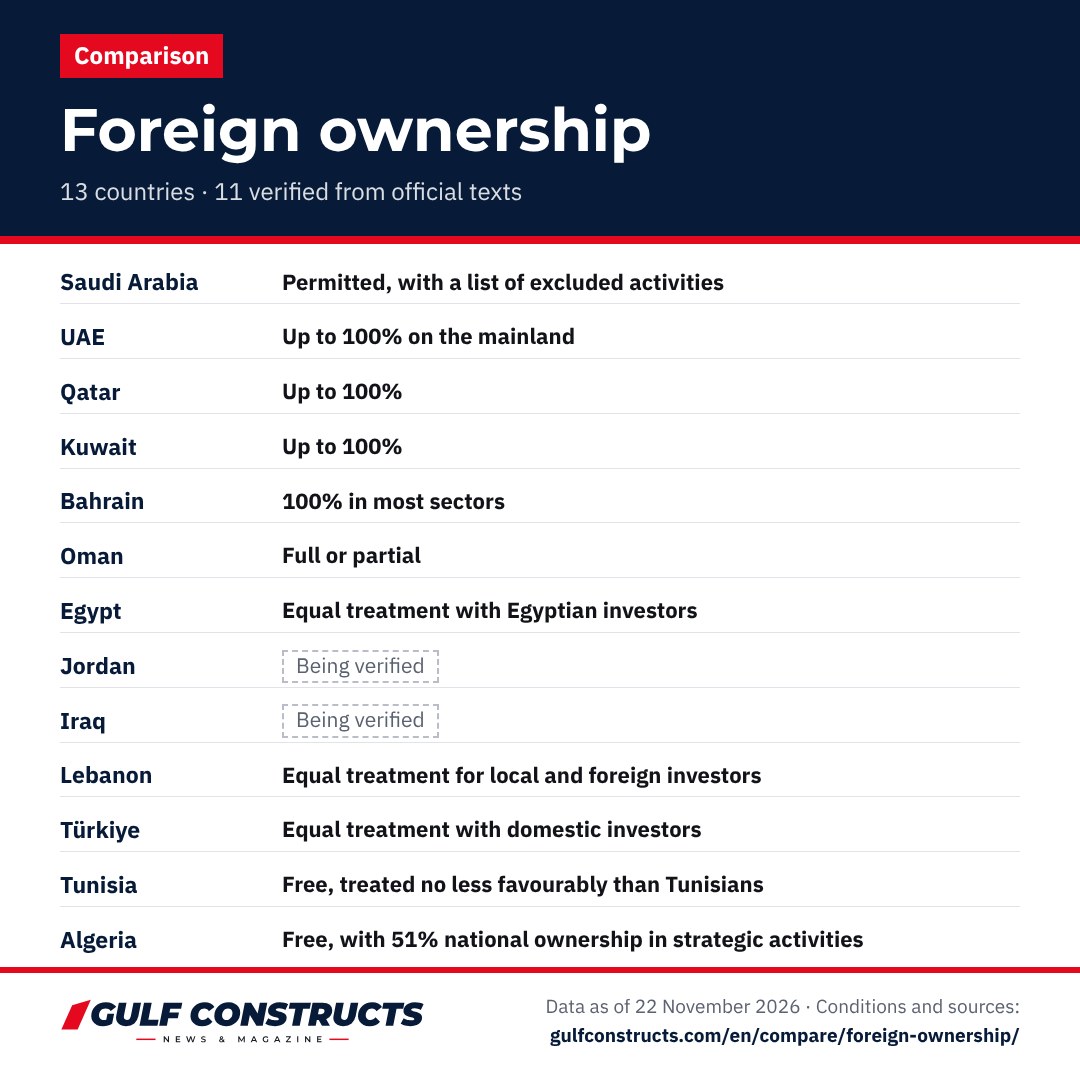
Foreign ownership in every country we cover, from the official text. We have verified 11 of 13 countries so far; the rest are marked “under verification” until we read the source.
Gulf states
| Country | Foreign ownership | Details as in the source |
|---|---|---|
| Saudi Arabia | Permitted, with a list of excluded activities | Foreign investors register with the Ministry of Investment before investing and may invest in any available sector, subject to the list of prohibited or restricted activities.1 |
| UAE | Up to 100% on the mainland | Since Decree-Law No. 26 of 2020, effective early 2021, except activities of “strategic impact” set by the Cabinet.2 |
| Qatar | Up to 100% | Except banking and insurance, natural resource exploitation, commercial agencies and sectors set by the Council of Ministers.3 |
| Kuwait | Up to 100% | In a Kuwaiti company incorporated for direct investment under Law No. 116 of 2013, except a negative list set by the Council of Ministers.4 |
| Bahrain | 100% in most sectors | The Commercial Companies Law allows full foreign ownership in most activities, with sector exceptions including some trading, government contracting and oil and gas activities, according to the Economic Development Board.5 |
| Oman | Full or partial | Investors may own the invested capital in whole or contribute to it in a permitted activity; prohibited activities are listed by ministerial decision.6 |
Middle East
| Country | Foreign ownership | Details as in the source |
|---|---|---|
| Egypt | Equal treatment with Egyptian investors | The state guarantees foreign investors the same treatment as national investors (Article 3), with the right to set up, fund from abroad without restriction, own the project and transfer profits and liquidation proceeds (Article 6).7 |
| Jordan | Under verification | Being verified against the official source. |
| Iraq | Under verification | Being verified against the official source. |
| Lebanon | Equal treatment for local and foreign investors | According to IDAL, Lebanon’s legal framework meets international standards and offers equal treatment to local and foreign investors.8 |
| Türkiye | Equal treatment with domestic investors | Foreign direct investment is free and foreign investors receive the same treatment as domestic investors; expropriation or nationalisation only for public interest against compensation, with free transfer of profits and sale and liquidation proceeds abroad (Article 3).9 |
North Africa
| Country | Foreign ownership | Details as in the source |
|---|---|---|
| Tunisia | Free, treated no less favourably than Tunisians | Article 4: “Investment is free”, subject to the legislation on exercising economic activities. Article 7: foreign investors must not be treated less favourably than Tunisian investors in like circumstances. According to the Tunisia Investment Authority, investment is not restricted in most sectors.1011 |
| Algeria | Free, with 51% national ownership in strategic activities | Article 2 of Law 22-18: freedom to invest for any national or foreign, resident or non-resident person. Since the 2020 Finance Law, the 49/51 rule is limited to strategic activities (mining, upstream energy, military industries, railways, ports and airports, and pharmaceutical industries except some innovative essential products) and to importing goods for resale as is.12 |
All criteria in one table Embed this table on your site
This comparison as an image
Other criteria
- Corporate tax
- VAT
- Investment legal framework
- Foreign property ownership
- Investor residency
- Free & economic zones
Sources
- Investment Law — official translation, Ministry of Investment (Council of Ministers Resolution 40, 16 July 2024)
- Full foreign ownership of commercial companies — The Official Portal of the UAE Government (Official page)
- 100% foreign ownership in Qatar — Invest Qatar (Official page)
- Law No. 116 of 2013 on the Promotion of Direct Investment — WIPO Lex (promulgated 16 June 2013)
- Bahrain Economic Development Board — Investor Questions on Bahrain’s Regulations (5 December 2025)
- Foreign Capital Investment Law (Royal Decree 50/2019) — WIPO Lex (issued 1 July 2019)
- Investment Law No. 72 of 2017 — GAFI English translation (including Law No. 160 of 2023 amendments)
- Legal framework — IDAL (Official page)
- Foreign Direct Investment Law No. 4875 — Turkish legislation portal (Turkish) (enacted 5 June 2003)
- Investment Law 2016 — unofficial translation by the Tunisia Investment Authority (the Arabic text prevails) (2016)
- Legal framework — Tunisia Investment Authority (Official page)
- Foreign investment in Algeria — AAPI (French) (Official page)
Sources accessed:
Published content is for general information only and is not investment advice.