


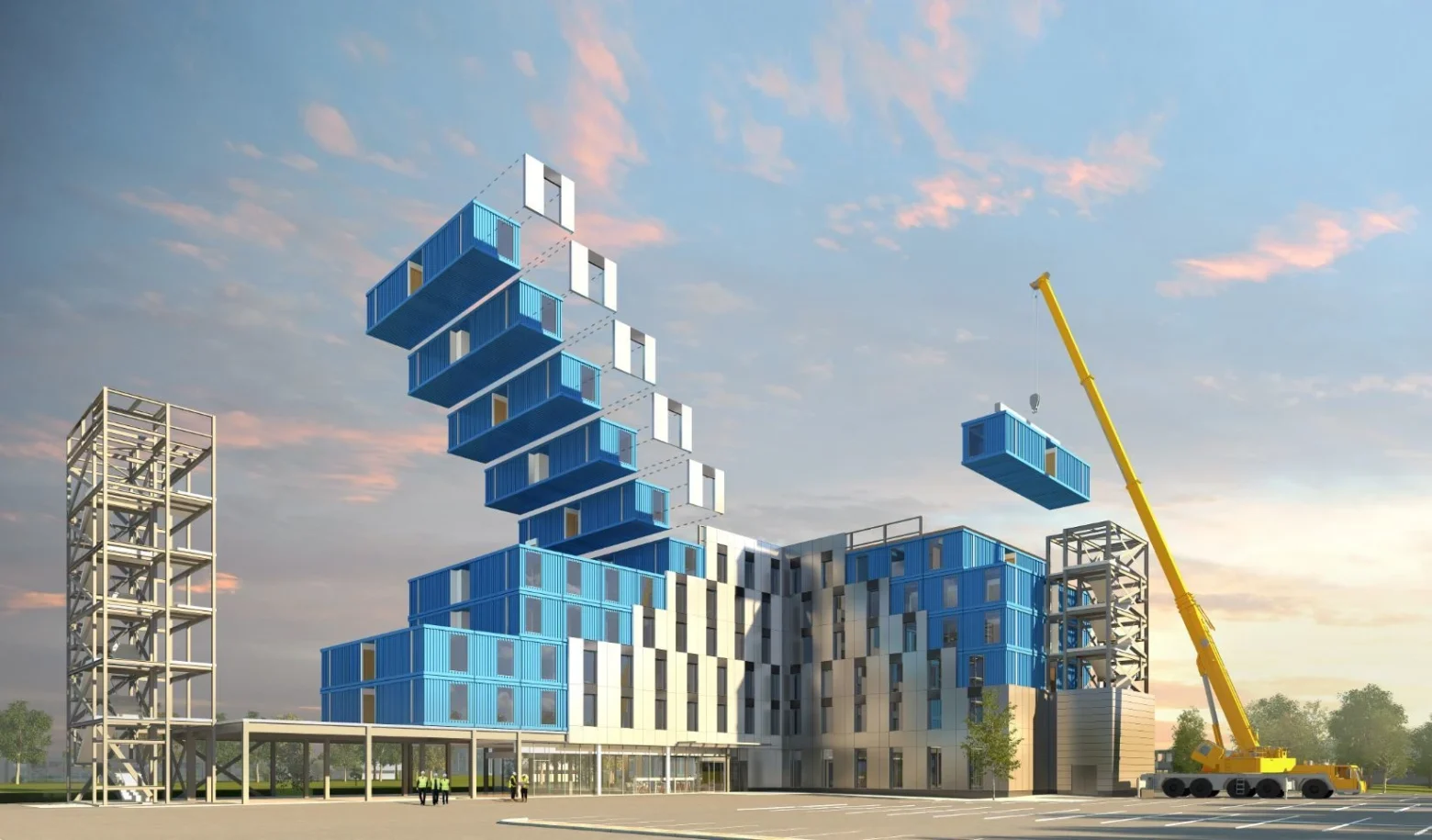
How off-site manufacturing, AI-driven design, and accelerated build cycles are redefining cost efficiency, sustainability, and delivery across the Kingdom’s construction landscape.
Saudi Arabia’s construction sector is entering a decisive new chapter. As the Kingdom accelerates its Vision 2030 agenda, modular and off-site construction has moved from a niche solution to a strategic necessity—powering giga-projects, easing housing demand, and reshaping how buildings are designed, manufactured, and delivered.
According to the latest industry research by IMARC Group, the Saudi Arabia modular construction market reached USD 877.1 million in 2025 and is forecast to grow to USD 1,381.6 million by 2034, registering a 5.18% CAGR between 2026 and 2034. Behind these figures lies a structural shift toward factory-based construction, digital coordination, and industrialized building systems aligned with national transformation goals.
AI and Digitalization: Redefining Modular Construction
Artificial intelligence and advanced digital tools are rapidly transforming modular construction across the Kingdom—improving precision, reducing waste, and accelerating timelines at an unprecedented scale.
BIM and AI-Powered Design Optimization
The integration of AI algorithms with Building Information Modeling (BIM) is enabling instant optimization of modular designs. Structural clashes and coordination conflicts are identified before manufacturing begins, reducing factory rework by as much as 40% and ensuring seamless downstream assembly.
Robotics and Automated Manufacturing
AI-driven robotic systems are now automating key factory processes, including rebar cage fabrication and volumetric module assembly. This shift delivers consistent quality, improves safety, and reduces labor dependency—critical advantages as Saudi Arabia scales industrialized construction.
Predictive Quality Control
Machine-learning systems continuously monitor production lines, flagging defects in real time and triggering automated adjustments. The result is higher-grade modular output with significantly lower material waste—supporting both cost control and sustainability goals.
Smart Logistics and Digital Twins
AI-enabled logistics platforms optimize material procurement and transport routes, synchronizing just-in-time deliveries to mega-sites such as NEOM. Digital twin technology further accelerates delivery by simulating entire construction workflows virtually, cutting overall project timelines by 30–50%.
Vision 2030: The Catalyst Behind Modular Growth
Saudi Vision 2030 has emerged as the single most powerful driver of modular construction adoption. The Kingdom’s giga-projects demand speed, scale, and sustainability—criteria that traditional construction struggles to meet.
NEOM alone has awarded multi-billion-dollar modular contracts, including large-scale residential developments delivered by Sweden’s SIBS AB, covering thousands of apartments across dozens of buildings. The ambitious The Line plans to deploy modular methods across more than one-third of its built environment.
Industrial capacity is expanding rapidly. China Harbour Engineering Company has inaugurated a 200,000-square-meter modular production facility in Riyadh to support ROSHN’s Sedra housing program, while Gulf Development International has announced a 1.4 million-square-meter modular assembly plant in NEOM with annual capacity exceeding 12,500 units.
Government support is equally decisive. The Ministry of Municipal and Rural Affairs and Housing is actively promoting modular construction to address an estimated housing gap of more than 1.5 million units, with public tenders increasingly mandating modular fabrication and BIM integration.
Market Trends Powering Adoption
Speed, Scale, and Certainty
Saudi Arabia’s giga-projects—from Red Sea Global to Qiddiya—require compressed schedules and predictable delivery. Modular construction consistently reduces end-to-end timelines by 20–50%, while trimming costs by approximately 20% at scale.
Sustainability in Harsh Environments
Factory-controlled environments allow year-round production, eliminating weather-related delays and minimizing site disturbance. Some modular projects in the Kingdom have achieved up to 45% reductions in carbon emissions, directly supporting the Saudi Green Initiative.
Localization and Industrial Growth
Programs such as IKTVA are incentivizing in-Kingdom manufacturing, encouraging local content development and advanced production capabilities. Established players like Red Sea International and AMANA Group have collectively delivered over 130,000 square meters of modular construction in Saudi Arabia since 2012, demonstrating proven local expertise.
Market Segmentation Snapshot
The Saudi modular construction market spans a wide range of applications and formats:
-
By Type: Permanent, Relocatable
-
By Module Type: Four-sided, Open-sided, Partially open, Mixed modules, Primary-structure supported
-
By Material: Steel, Concrete, Wood, Plastic, Others
-
By End Use: Residential, Commercial, Education, Retail, Hospitality, Healthcare
-
By Region: Central & Northern, Western, Eastern, Southern Saudi Arabia
Looking Ahead
With continued investment, regulatory alignment, and technology adoption, modular construction is set to become a cornerstone of Saudi Arabia’s built environment. As giga-projects scale and housing demand intensifies, off-site manufacturing offers the speed, certainty, and sustainability required to deliver Vision 2030—on time and at scale.
Web Search Results
-
Saudi Modular Construction Market | 2019–2030
Overview of market size and growth drivers, highlighting Vision 2030, urbanization, and sustainability demand. -
Modular and Off-Site Construction: The Next Normal in Saudi Arabia
Analysis of how modular construction is becoming a mainstream solution across Saudi mega-projects. -
Modular Construction in Saudi Arabia: A Fast-Track Solution for Vision 2030
Insight into off-site construction benefits for speed, cost efficiency, and sustainability. -
Kingdom of Saudi Arabia Vision 2030
Official Vision 2030 document outlining national transformation goals and infrastructure priorities. -
Saudi Arabia Modular Construction Market Size & Forecast
Market forecast projecting strong growth through 2032 driven by housing and giga-projects. -
Construction Innovations in Modular Buildings in Saudi Arabia
Review of recent innovations reshaping modular building practices across the Kingdom.
- Achieve Efficiency with Flow & Control’s Comprehensive Fire Protection Services
- Gulf Ektimal: Enhancing Residential Property Management in Dammam, KSA
- Innovating Energy Efficiency: Flow & Control’s Approach to Sustainable MEP Services
- Flow and Control Company: Enhancing Energy Efficiency in HVAC Systems in Saudi Arabia

